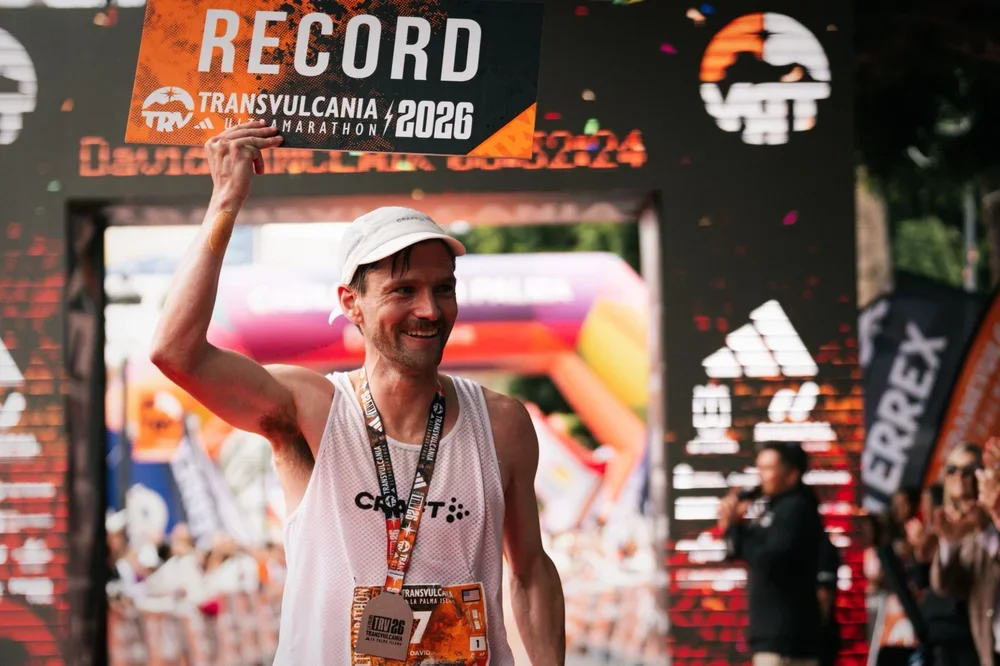
Trail running history was rewritten this weekend as Transvulcania 2026 delivered a seismic shift in the sport. Eight records were broken across eight distances, six of them in a single day, transforming the La Palma race into one of the most extraordinary and defining events the global trail running scene has ever witnessed.
At the epicenter of this earthquake stands a name that, until just a few months ago, was not on the front pages of international ultratrail: David Sinclair. The American delivered a performance already etched into the history of mountain sports, stopping the clock at 6:32:24—slashing 19 minutes off the record held by Luis Alberto Hernando for more than a decade.
And this was no ordinary record. The mark set by the Burgos runner belonged to an era that helped build the modern legend of trail running, a time when athletes like Luis Alberto Hernando and Kilian Jornet staged some of the most iconic duels the sport has ever seen. That generation raised the competitive bar in the mountains as never before. But what happened in La Palma now points to an entirely different level.
The magnitude of the achievement is even clearer with a striking statistic: the top six finishers in the men’s ultramarathon all ran faster than Hernando’s historic time. That is no coincidence. It is a signal.
The new era of trail running has arrived.
The feeling left by Transvulcania 2026 inevitably recalls the great evolutionary leaps seen in road athletics. The most recent example came just days ago at the London Marathon, when Kenyan Sabastian Sawe became the first athlete to officially break two hours with a historic 1:59:30. And the scale of that leap was even greater because he did not run alone at that frontier—Ethiopian Yomif Kejelcha crossed the line just eleven seconds later, also under two hours, with 1:59:41.
That same phenomenon is now migrating to the mountains. For years, trail running lived under the romantic notion that terrain hardness made such aggressive time improvements impossible. But reality is shifting at a brutal pace: extreme professionalization, millimeter-perfect nutrition, altitude-specific training, power monitoring, and a new generation of athletes capable of sustaining rhythms unthinkable just five or six seasons ago.
Soineclair’s feat does not seem like a simple individual display. It looks like a warning that ultra distance has entered its own “supersonic era.”
From European dominance to absolute globalization.
Transvulcania 2026 also reveals a deeper narrative: trail running is now fully global. The presence of African and North American runners has changed the competitive pace of major races. Athletes accustomed to high speeds on roads and middle distances are bringing that velocity to environments where more conservative strategies once prevailed.
And Sinclair epitomizes this new blend: extreme endurance, sustained speed, and the ability to run aggressively from the very first kilometer.
Zegama, Western States, and UTMB: fear is now installed.
The big question now is how far this new generation can go. Because the calendar is entering its most decisive stretch. The next major test will be Zegama.