
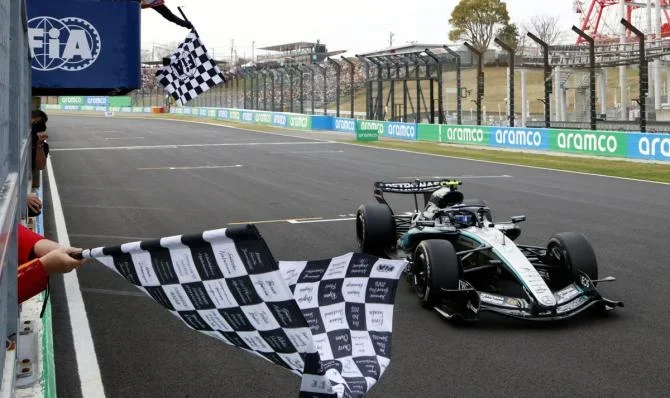
Artificial intelligence is rapidly reshaping Formula One, with teams such as Williams and Red Bull leveraging AI for race strategy, data analysis, and operational efficiency, as tech partnerships and sponsorship revenues continue to surge.
The integration of AI into Liberty Media’s Formula One and its 11 teams has become increasingly evident both on and off the track, even in a sport already defined by high-tech innovation. According to research firm Ampere Analysis, eight new AI partnerships were signed in the last six months alone.
Among them, nine-time constructors’ champion Atlassian Williams has teamed up with AI company Anthropic, using its Claude model to support team operations and race strategy. “It’s much more than a sticker on a car or a sticker on a billboard,” said Peter Kenyon, Board Advisor for Williams. “We see it as one of our differentiating points: how can this partner help us in that journey back to the top?”
While past F1 partnerships often centered on tobacco brands, today’s deals frequently involve AI and tech companies that help teams interpret data while gaining significant exposure. “What Anthropic and our tech team are doing are understanding the opportunities and then integrating those into our business to be able to demonstrate for ourselves and them, and showcase their technology in the pursuit of getting Williams back to the top,” Kenyon added.
AI has become a key tool for teams navigating new regulations and cost cap rules, now set at $215 million. “Efficiency is one of the ubiquitous benefits of AI products, meaning a natural synergy between teams and AI brands,” said Adam Lewis, senior analyst at Ampere Analysis.
According to intelligence platform SponsorUnited, technology led the top 10 spending categories for F1 teams, reaching an estimated $769 million last season—a 41% increase from the previous year. AI and machine learning brands accounted for four of the top 15 new sponsorship investors, including $65 billion-valued cloud infrastructure company CoreWeave, which has partnered with Aston Martin. In the 2025 season, total team sponsorship reached $2.54 billion, making F1 the second-highest grossing sports property behind the NFL’s $2.7 billion.
AI has also proven innovative in handling administrative tasks and interpreting key sporting and technical regulations, enabling engineers to make faster decisions during races—something impossible decades ago. “So it’s gone from a sort of basic AI to more of an agentic approach where rather than just searching for something, it’s actually providing decisions for us,” said Jack Harington, group partnership lead for Oracle Red Bull Racing.
The Red Bull team, for which four-time champion Max Verstappen drives, has a partnership with $494 billion-valued software company Oracle, embedding its technological expertise across the team. “So it’s really playing into the strength of AI as an enabler for our team. Allowing them (engineers) to focus on the core responsibilities they have and perform better at what they do,” Harington added.
Technology giants like Alphabet-owned Google are also seeing benefits from entering F1. “These blue-chip companies are using Formula One as a launchpad and spotlight for their own AI products or re-brandings,” Lewis noted, pointing to Google’s partnership with McLaren shifting from Google Pixel to Google Gemini, a generative AI tool.
The sport itself has embraced AI. Its partnership with Amazon Web Services uses generative AI for live television broadcasting, and in 2024, generative AI was used to design the Montreal trophy, originally crafted by a UK silversmith. “I think F1 has the never-ending, unquenchable thirst for the latest technology,” said Arthur Hu, Global Chief Information Officer at Lenovo.
Lenovo, a Hong Kong-listed technology company, has been a global partner of F1 since 2022. Hu explained that Lenovo helps enhance productivity, mobility, and remote collaboration through laptops and devices, including AI PCs, supporting race delivery. “Formula One is at the sweet spot where it’s an intensely technical sport… And so I think that only opens up new possibilities,” Hu said.